


BY LERATO PHOSISI
It no longer feels like policy disagreement or diplomatic strain — it feels as though South Africa has declared a war between its borders and neighbouring countries. Not a war of artillery, but one of attrition: of paperwork, of hunger, of suspicion that settles over bus depots and townships alike. Today, that war had a postcode. It was Phumlamqashi Informal settlement in Johannesburg South .
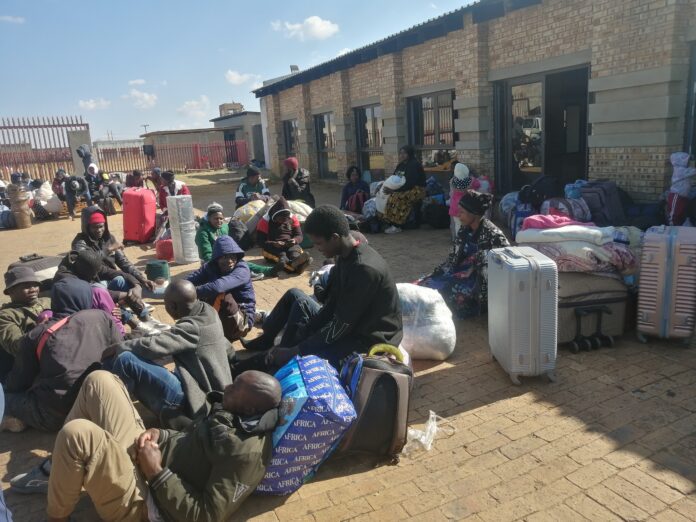
At 8am sharp, a convoy of 19 buses exhaled 800 weary Malawian souls into the Phumlamqashi Depot. What should have been a two-hour driver swap became a day-long humanitarian crisis — children wilted on concrete, mothers breastfed on hunger, and a township held its breath.
The buses came from Durban. Their drivers, uneasy about continuing to Pretoria, had arranged to hand the steering wheels to Phumlamqashi locals. But when residents saw the fleet rolling in at dawn, panic sparked. Phones lit up. Police were called. “They’re coming to live here,” the fear went. They weren’t.
Yet by midday, the depot was a portrait of limbo. More than 800 men, women, infants and children sat marooned without food. Water was the only mercy.
Praise Masamba, 26, smoothed the edges of her passport. “I earn R600 a month in a shop. A work permit is R6000. How?” she asked, voice flat with arithmetic that never balances. “I’m going home. We have no choice. I’ll farm. That’s how we survived before.”
Blessing Ndambiriri had fled Durban at 1am. “They chased us from our houses. No time to pack. Passports left behind. Furniture, everything gone. They took our belongings. We were assaulted, robbed. We were already planning to leave before 30 June. The situation was deteriorating. We are not coming back. The people here are cruel. They have no humanity.”
Phumlamqashi’s depot manager Ridwaan Moosa said the operation blindsided them. “We didn’t expect buses. The arrangement was between the owners Durban and Phumlamqashi . Their drivers only do national routes. No passports. So the buses had to come here. But residents thought they were here to stay. We couldn’t do business today. It’s affected us badly.”
He looked out over the crowd, now baking in the afternoon sun. “They’ve been here since 8am. No meal. As much as we’d like to help, it’s beyond us. 19 buses who do you feed first? These people were already prepared to leave. They’ve admitted they were here unlawfully. Yet we still want violence? They can’t even buy food. Residents threaten to fight them. It’s unfair.” said Moosa
One act of grace pierced the stalemate. Lieutenant Colonel Moeketsi of SAPS bought food for the children after realizing they had gone hours on nothing.
The South African Police Service, Flying Squad, and Department of Home Affairs formed a tight cordon around the depot. Passports were checked. Manifests verified. Law, at least, was present.
Mayoral Committee (MMC) Sithembiso Zungu for group corporate and shared services in the City of Johannesburg, arrived amid the tension, moving between officers, officials, and anxious residents. “The municipality has activated joint operations with SAPS and the Flying Squad to secure the perimeter,” he said. “We’ve created a buffer zone between residents and passengers. Our priority is de-escalation getting this exchange done swiftly, safely, and with dignity, especially for the women and children.”
He was blunt about the municipality’s role. “SAPS leads on security. Home Affairs handles immigration compliance. We’re coordinating. We’re monitoring humanitarian conditions. We’re ensuring bylaws are respected.
Resident Jeffrey Mphojoni was unmoved. “We’re here to ensure foreign nationals are out of our area and our country. Today we’re not working because of them. There’s high crime from undocumented foreigners. Mabahambe.”
MMC Sithembiso Zungu answered the sentiment without flinching. “We acknowledge residents’ fears and frustrations. Today shows why transport operators can’t make unilateral decisions that impact entire communities. Going forward, we will require advance notification and permits for large-scale driver exchanges in residential areas. Phumlamqashi cannot be an ad hoc transit hub. We’ll convene an urgent stakeholder forum — depot owners, resident associations, law enforcement — to set clear rules. Community safety and social cohesion are non-negotiable.”
As the sun dipped, the driver swap inched forward. Engines idled. Babies cried. A nation watched a single bus depot and asked itself the hardest question: Is South Africa safe now?
For the 800 stranded at Phumlamqashi, safety tonight means a full stomach, a completed journey, and a border behind them. For the residents, it means reassurance that their streets will not change overnight. For South Africa, it means confronting a truth too raw for protocol: desperation and fear cannot share the same square of pavement without consequence.
